

Volumetric Flask Uses in Laboratory: Applications, Sizes and Precautions
What is the Uses of a Volumetric Flask?
Laboratories utilize a volumetric flask to make solutions containing accurate and precise volumes. It is widely applied in chemical laboratories in the preparation of standard solutions, dilutions and sample preparation to carry out a titration experiment.
Analytical results are very reliable because Flasks used in the laboratory require proper volumetric flasks.
The volumetric flasks may be explained in greater detail as follows: (To see a detailed manual on volumetric flasks, please read this: Volumetric Flask – Uses, Diagram and Working).
Applications of Volumetric Flask in the Laboratory.
The volumetric flasks are very critical glassware in the laboratory of analysis and research since they enable the scientist to prepare the solutions with precise concentrations.
1. Preparations of Standard Solutions.
A volumetric flask has one of the most significant applications in the making of standard solutions to be used in chemical analysis.
The concentrations of these solutions need to be accurate, hence the design of volumetric flasks has a calibration mark that shows the exact amount of this.
2. Dilution of Chemicals
Scientists usually require dilution of concentrated chemicals to certain levels.
This can be done with a volumetric flask whereby the solution can be filled up to the volume marked.
3. Titration Preparation
On titration experiments, the reagents are made in volumetric flasks, and they are transferred to burettes.
Proper solution preparation results in the proper titration.
4. Pharmaceutical Testing
Volumetric flasks are utilized in pharmaceutical laboratories to prepare drug testing and quality control reagents and chemical test samples.
5. Analysis on Environment and Water.
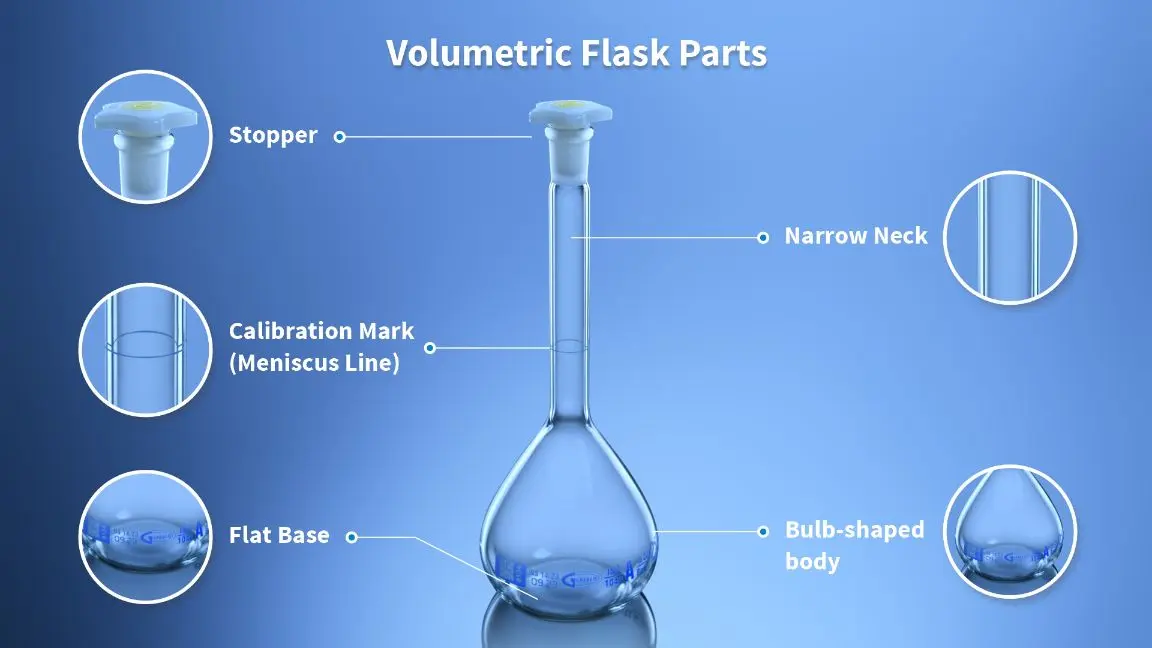
Volumetric Flask Parts
Main parts include:
- Bulb-shaped body – Keeps the solution in preparation.
- Narrow neck – Assist in attaining proper measurement during fill up to the calibration line.
- Calibration mark – Shows the volume that is specified in the flask.
- Flat base – Enables the flask to be placed on the lab surfaces safely.
- Stopper – Used to close the flask during the preparation of solutions.
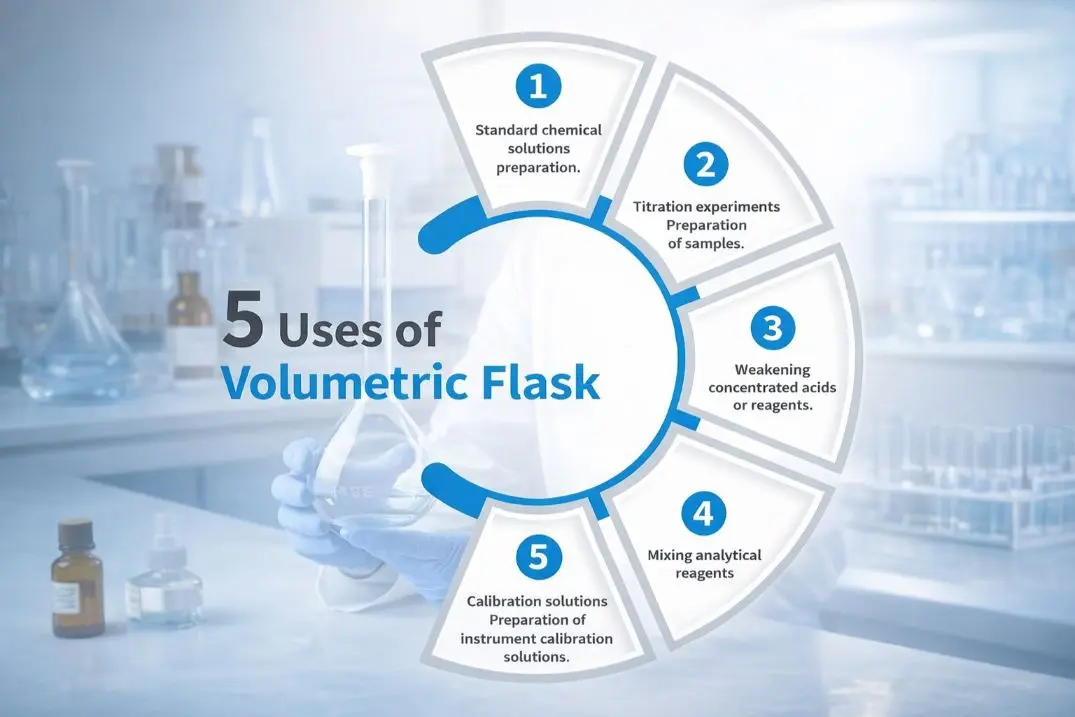
5 Uses of Volumetric Flask
Five typical uses of the volumetric flasks in the laboratories are listed here:
- Standard chemical solutions preparation.
- Titration experiments Preparation of samples.
- Weakening concentrated acids or reagents.
- Mixing analytical reagents
- Calibration solutions Preparation of instrument calibration solutions.
Volumetric flasks come in various sizes based on the requirements of the laboratory.
Common sizes include:
- 10 mL
- 25 mL
- 50 mL
- 100 mL
- 250 mL
- 500 mL
- 1000 mL
As an example, the volume of 100 milliliters of solution is prepared to the point of high precision in a 100 mL volumetric flask.
Volumetric Flask Safety.
- It is always advisable to read the meniscus on eye level.
- Add the liquid to the mark of calibration.
- Clean the flask prior to use.
- Do not put the flask directly into heat.
Conclusion
To learn more about volumetric flasks, their diagram and operation principles, visit the entire tutorial on Volumetric Flask Usages, Diagram and Functions.