

What is a Volumetric Flask? (Ultimate Guide)
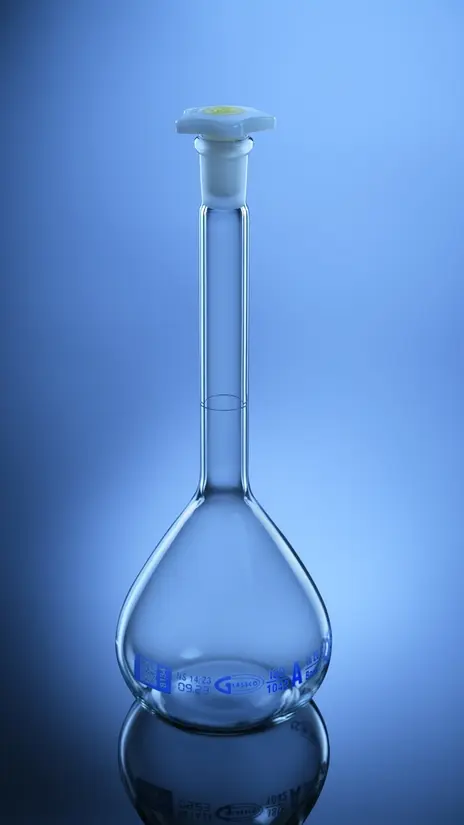
A volumetric flask is an accurate glassware common in the laboratory, and is used to prepare solutions of known and immobile volume, which is usually indicated by a calibration line (meniscus mark) that provides precision in measurement.
And you can also say a volumetric flask is a flat bottom or pear-shaped laboratory flask that is used to measure a precise volume of a liquid.It is marked with one mark of graduation on the neck to show the exact volume (e.g. 25 mL, 100 mL, 250 mL, 500 mL, 1L). It is primarily applied in instances when preparation of solutions needs accuracy and precision.
Complete List of Volumetric Flask Uses.
Applications Volumetric flasks are applied in:
- Standard solutions Preparation of standard solutions.
- To titrate or calibrate or to analyze quantitatively.
- Dilution of stock solutions
- In order to prepare lower-concentration solutions.
- Analytical chemistry tasks
- Where precision is important on molarity or volume.
- Making buffer solutions
- In the case of experiments that require a constant pH.
- Volumetric titration (volumetric analysis)
- Combined with burettes and pipettes.
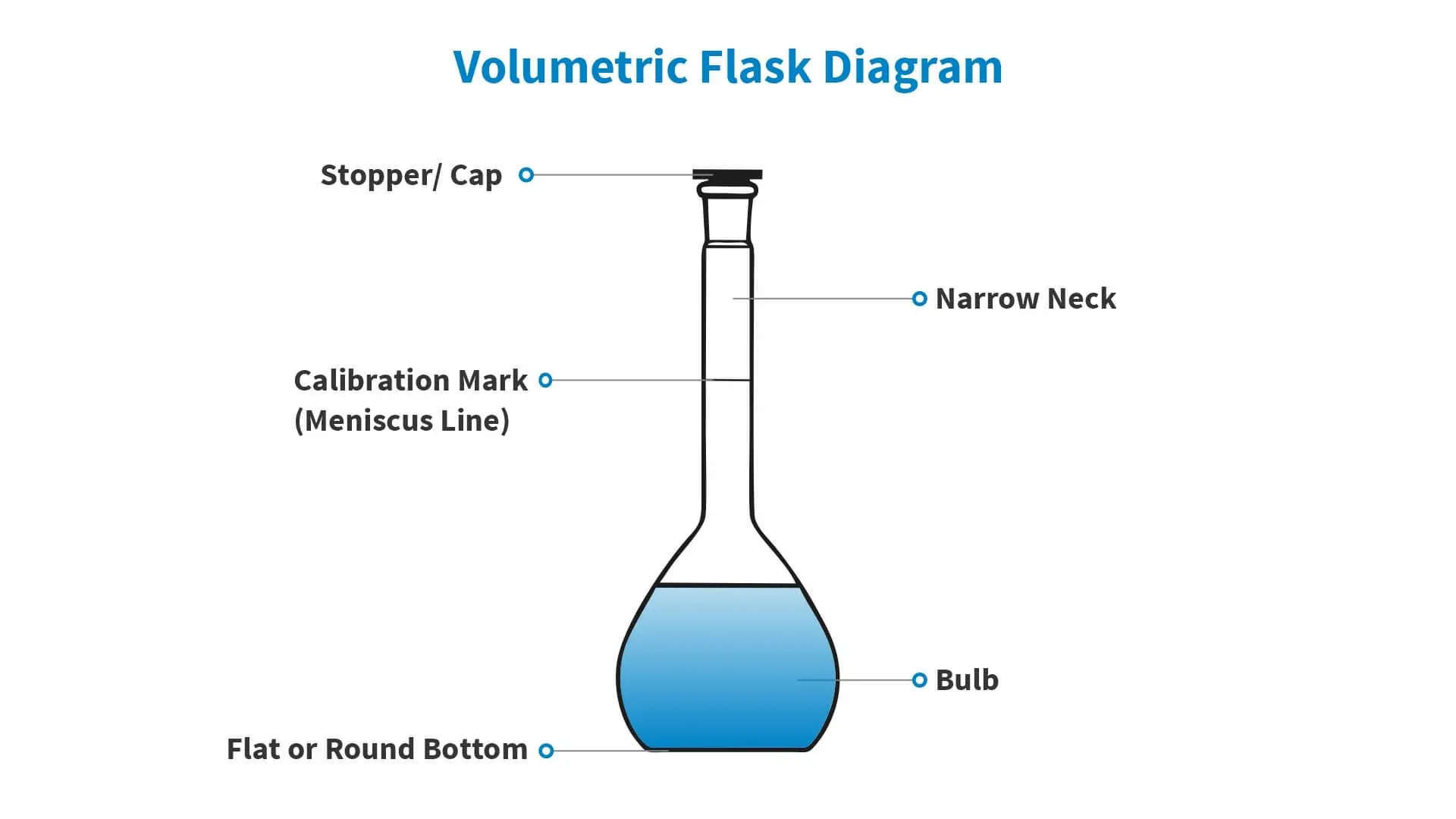
Parts of a Volumetric Flask :
- Bulb – the large lower section which contains the larger liquid.
- Narrow neck – provides a narrow neck so that it is accurate in reading.
- Calibration mark (meniscus line) – one line (concrete volume).
- Flat or round bottom – according to model
- Stopper/ Cap – glass or plastic, holds solution closed.
Volumetric Flask Diagram:
Here is the full diagram of a volumetric Flask
What is a Volumetric Flask made of?
Usually volumetric flasks are constructed of:
Borosilicate (mostly used) glass
- Heat resistant
- Chemically stable
- Transparent for accurate meniscus reading
Polypropylene (PP) or plastic
- Suitable with non-temperature solutions.
- Shatter-resistant
- Used in field labs
Why is this glassware so accurate?
They provide the most accuracy as they:
- Contain one calibration mark.
- Neck is narrow in order to have a clear reading of the meniscus.
- Calibrated in specific temperature (20 degree C).
- Bulb develops stable liquid volume (error reduction).
Accuracy Class:
- Class A – highest accuracy
- Class B – general use
Types of Volumetric Flasks:
- Volumetric flask with single marks:
- Most prevalent – a single calibration line.
- Amber volumetric flask:
- In case of light sensitive chemicals.
- Plastic volumetric flask:
- When field work and no critical measurements are required.
Common Errors & How to Avoid Them:
- ❌ Meniscus not aligned
- ✔️ Read at eye level.
- ❌ Filling above the mark
- ✔️ Use dropper when close to line.
- ❌ Using a warm or hot flask
- ✔️ Always work at 20°C calibration temperature.
- ❌ Not mixing after filling
- ✔️ Invert 10–15 times.